


Secrets of Exciting Chords & Chord Progressions: Lesson Eight
All The Major 6th Piano Chords
The first of the extended chords group
Hello again, and welcome to the next edition of the newsletter. I hope you are enjoying learning about all the chords in the world — and we’re going to cover them ALL before we’re done — you’ll know more about chords than 99% of the people in the world — believe it or not, it’s true.
Then in the next weeks lesson we showed you how easy it is to learn ALL the major chords (there are 12 of them) and be able to play them in seconds — not hours or days or weeks or months or years. Some people go through their entire lives not being sure about what such and such a major chord is — and it’s all so unnecessary, because you can memorize them in just a few minutes, and learn to play them in 12 seconds or less – one second per chord. I have had many private students over the years who could play them all in as little as 5 seconds — one little gal (she was about 12 at the time) had particularly fast hands, and could play them in – believe it or not – 3 seconds! I have slow hands with fat fingers, and yet I can play them in something like 5 or 6 seconds.
Then we learned inversions — how to stand chords on their head.
And finally, we took up augmented triads — formed by simply raising the 5th of a major triad.
Today we are going to learn major 6th chords. They are 4-note chords — the root, 3rd, 5th — just like a major chord, but you also add the 6th degree of the scale to the major triad. The 6th is ALWAYS one whole step above the 5th — never a half step — so they are real easy to find.
Today we will change those major 6th chords into minor 6th chords just by altering the 3rd 1/2 step — in other words, a minor triad with a 6th on top.
So here is the formula for a minor 6th chord:
A Major 6th Chord = Root 3rd 5th 6th
Here’s what Major 6th piano chords look like on the staff:
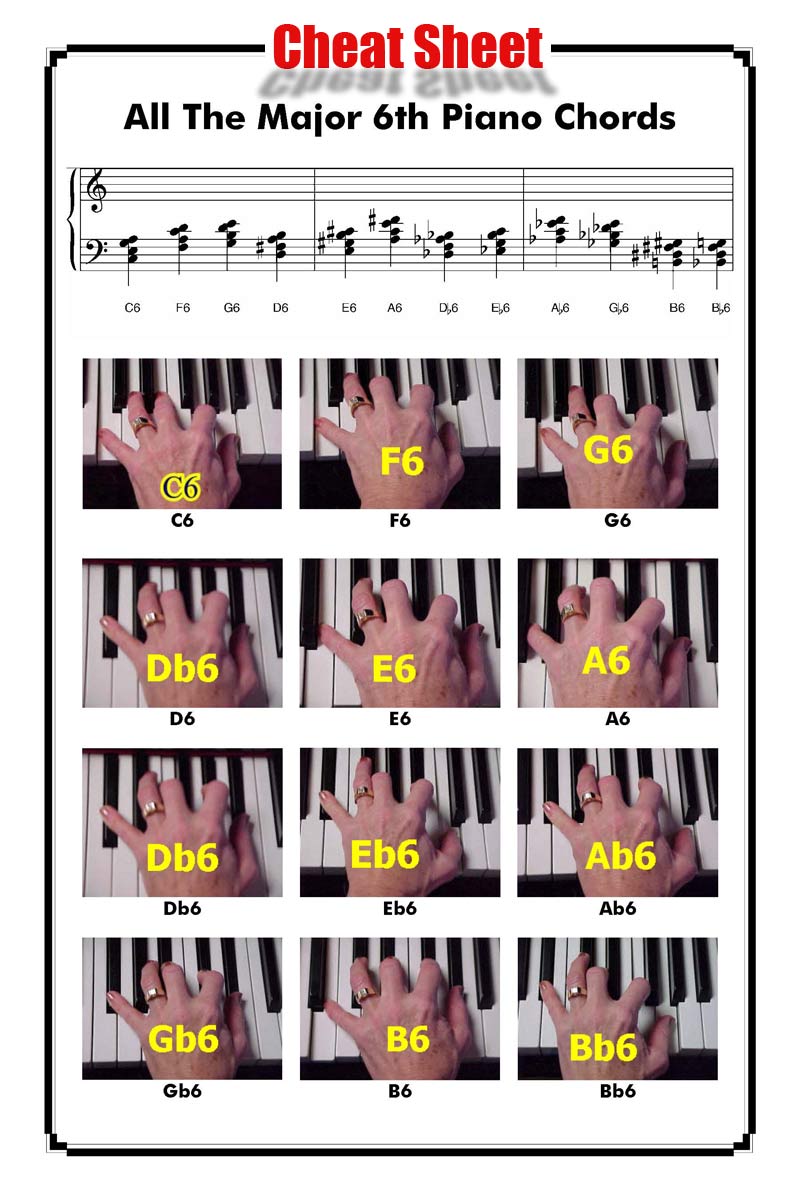
As usual, now it’s up to you. Play each minor 6th chord in root position, then 1st inversion, then 2nd inversion, then in 3rd inversion (the 6th will be the lowest note of the chord) Play each chord up and down the keyboard for at least 2 octaves — maybe 3 octaves. Play them with your left hand, then play them with your right hand. Then play them hands together.
Go through all 12 major chords, inverting every one. Then go through all the 12 minor chords, inverting each one up and down the keyboard — hands alone, then hands together. Then go through all 12 diminished chords, inverting each one up and down the keyboard — each hand alone, then together. Then play the 12 augmented chords, up and down the keyboard. Then skip around from major to minor to diminished to augmented, etc.
Now add minor 6th chords to your repertoire of chords. They are shown in root position above, but you know that you can turn them upside down ’till the cows come home — invert them — so go to it!
When you can do that you ought to feel really, really, really, really optimistic about learning chords, because you’re on your way! After all, you have gone from:
12 major piano chords
to
12 minor piano chords
to
12 diminished piano chords
to
12 augmented piano chords
and
12 major 6th piano chords
and
12 minor 6th piano chords
and
inversions of each piano chords
which means you can now play 192 piano chords!
Good for you!
Next week we will add 12 more chords to our growing list of chords we can play by adding minor 6th chords to our stash. (Actually 48 more chords, since each 4-note chord such as a minor 6th can be inverted 4 ways — root position, 1st inversion, 2nd inversion, and 3rd inversion.
If you are more advanced and are anxious to learn how chord progressions work, order this course: